If you are wondering what ground-down teeth are good for, how to eat with ground-down teeth, what to pay attention to in order to avoid damage and pain, or what kind of crown to choose for them, then you have come to the right place.
Ground-down tooth – A necessary evil?
The dentist holds a filed tooth in their hand, demonstrating the process to the patient.
If a tooth can no longer be restored with a cosmetic filling or a ceramic veneer (for example, in cases of significant tooth structure loss, extensive wear, or enamel development disorders), then a crown may be necessary.
However, a crown needs to be fitted for stability, so the affected tooth will need to be ground down.
When removing tooth structure (during grinding), particular care must be taken to preserve the hard tissue. The Naturadent Aesthetic and Laser Dentistry team's principle is that every patient should leave our practice with as much sound (still restorable) tooth structure as possible.
This is why our specialists only remove as much tooth material as is necessary for the crown's stability and retention. We affix the beautiful, comfortable, and perfectly functioning crown to the prepared tooth surface with a gap-free fit, using the most advanced adhesive materials, ensuring it can withstand chewing forces in the long term.
Why is a prepared tooth more sensitive?
The shaved teeth are missing their enamel layer. This is responsible for protecting the nerve and blood vessels within our teeth as an insulating shield against external factors like heat (extreme cold/hot). Without the protection of a shaved tooth, a patient who still has to wait weeks for a permanent crown would experience hellish pain.
Temporary crowns (made of plastic) play an important role in interim protection. On the one hand, they ensure that no one in the patient's surroundings notices the change in their smile after tooth preparation. On the other hand, they provide protection against dangerous pulpitis and necrosis. A new crown alone is not a guarantee of success: wearing an uncomfortable crown or one that is too high can also lead to pain and sensitivity.
At Naturadent, we take great care to ensure that even the temporary chairside or laboratory crown harmonises with your facial aesthetics, both in terms of colour and functionality.
To eat or not to eat, that is the (thorny) question!
A ground tooth and sensitivity/pain often go hand in hand. This is natural to a certain extent, but you need to watch out for the warning signs so that you can act in time if necessary.
If for any reason you have not received a temporary crown on your prepared tooth, it will be directly exposed to cold, warm and mechanical stimuli.
The general rule is to eat only foods that are not hot/cold/sweet, as the polished tooth/stump can be particularly sensitive to these types of foods and drinks.
Choosing the right painkiller can help you bridge the time until your permanent crown is fitted. However, it's important to stress that if you experience throbbing pain at night while lying down, you must visit your dentist immediately!
Besides hot and cold (foods, drinks), dehydration and alcohol can also cause a stinging, unpleasant sensation. Gum damage doesn't make the situation any easier, but alongside pain relief and fasting, there are other alternatives if you're looking for moments of relief even before the permanent crown is fitted.
Cleaning a ground tooth – Beyond sensitive toothpaste
To alleviate pain and sensitivity, it is often enough to rinse the ground tooth with lukewarm water to dissolve any deposits. Gentle brushing with sensitive toothpaste and a soft-bristled toothbrush is suitable for cleaning ground teeth and eliminating the sensitivity of the ground tooth surface.
Scrubbing and scrubbing are forbidden when cleaning the polished tooth! Of course, this is also not recommended for cleaning other teeth. You can read more about correct brushing technique and practical dental hygiene tips here.
Good news; decay and inflammation under a crown can also be treated effectively and quickly after the crown's removal. However, waiting is not a good tactic here either: if you experience pain, visit us at our exclusive city-centre practice so we can help as soon as possible!
Protecting the polished tooth - The way to a permanent solution
When the dentist grinds (prepares) the tooth for a bridge or crown, he or she must prepare the patient for what may be a frightening and unusual sight.
A polished tooth often looks more like a bone than a normal tooth. Many of the images of ground teeth flooding the internet look like someone has collected a collection of toothless vampires. But we're not here to scare you, we're here to help you, so please forgive us and we'll spare you from these kinds of photos.
X-ray of the tooth to be polished
To ensure that you get the crown that suits your needs (temporary, then permanent), we will take an impression of your polished tooth.
The most innovative laser dentistry in Hungary also uses a 3D, colour, digital intraoral scanner to take impressions. This means you don't have to worry about irritation caused by the impression material in your mouth.
At Naturadent, temporary chairside or laboratory-made crowns are perfectly suited for stump protection, as they protect against bacteria, as well as the aforementioned osmotic and temperature fluctuations, fractures and damage, and the gum growing over the shoulder created on the neck of the tooth.
With world-class equipment and top-quality materials, you can choose from a range of top-quality crowns in our practice.
If you are a proponent of natural solutions, the metal-free zirconium ceramic crown, made with CAD/CAM technology and eerily similar to the colour of natural teeth, is sure to please you.
One of its biggest advantages is that it does not conduct heat at all, so there is no oversensitivity to cold or heat that is typical of traditional metal frame crowns.
If you want to maximise mechanical resistance, we recommend a high-pressure pressed porcelain crown, which has a translucency similar to human teeth.
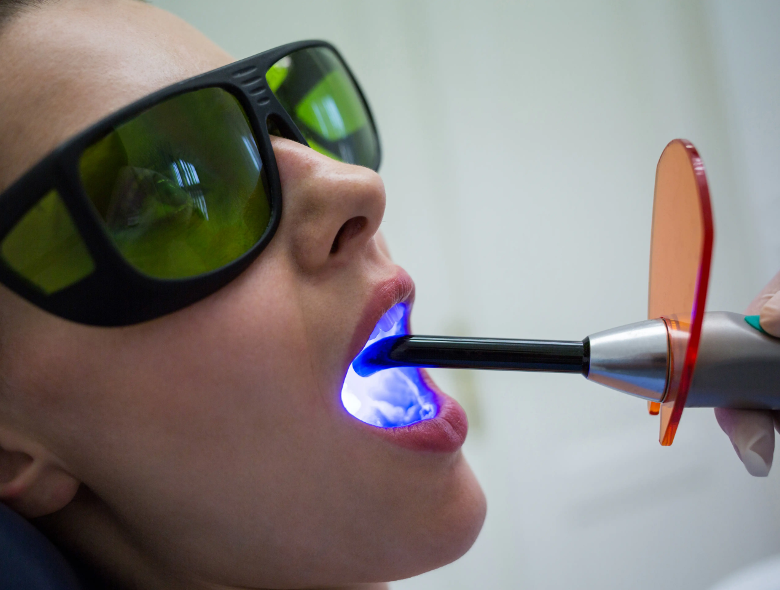
An additional advantage is that extremely little tooth material needs to be removed for placement (0.7-1 mm), so there is no need to worry about pulp damage to the prepared, ground tooth. Furthermore, with innovative, laser cavity disinfection, we minimise the chance of secondary decay.
The stability of the gold-ceramic crown is provided by a gold framework underneath the porcelain veneer. In addition to fitting the prepared tooth with extreme precision, it also has anti-inflammatory, antibacterial, and bacteriostatic effects. Therefore, there is a much lower chance of developing secondary decay, gum recession, or pocket formation compared to traditional metal-ceramic crowns.
In addition to the aesthetic and functional benefits, there are other considerations to think about before deciding on a permanent crown to protect your polished teeth in the long term.