Aesthetic dentistry offers dentists a wide range of options, even in cases where a patient’s teeth only require minor intervention, meaning orthodontics are not necessary, and at most, slight alterations to existing teeth are needed for a beautiful smile.
In such cases, applying direct veneers can be an excellent choice, the biggest advantage of which is that only a minimal amount of your own tooth enamel needs to be removed to achieve a sufficiently aesthetic final result.
Unlike the classic crown, this is a much more comfortable option that requires less getting used to, allowing you to achieve a beautiful smile and aesthetic appearance immediately.
What do you need to know about the direct veneer treatment offered by NaturaDent? Who is it recommended for and why is it a beneficial choice in certain cases? We've sought the answers to these questions in our latest article!
What is a direct shell?
Direct veneers are one of the best alternatives in aesthetic dentistry for smaller problems that do not require orthodontics to be eliminated with a simple procedure, making the patient's smile perfect.
The veneer itself is a composite layer made of a very thin yet strong material, which is always individually crafted by the dentist to fit the patient's dentition. Unlike a crown, it does not encase the entire tooth surface but is only placed on the outer front surface, meaning significant preparation of the tooth is not required. Dentists most often create them for the front teeth, incisors.
In the world of aesthetic dentistry, it can be considered an exceedingly gentle solution, as there are cases where no tooth reduction is necessary for the veneer to be applied stably and aesthetically.
Direct veneers are most often applied in the smile zone. They are mainly used on the upper incisors, but are also a good solution for the lower incisors. They can be used to cover part or all of the front surface of the teeth.
Direct veneers have evolved significantly over the past few decades. Whereas previously only the smallest corrections could be made in this way, using modern materials and technological support, also employed by NaturaDent, it's now possible to address the entire tooth surface without it being an obstacle.
Moreover, with the adhesives used nowadays, the delicate enamel layer can be fixed as powerfully as dentine binds to enamel, thus achieving outstanding results not only in terms of appearance but also durability.
The direct veneer is applied in layers by a dentist who uses materials of different colours and translucency to ensure a lifelike result.
Direct shell types
Basically, direct peel can be divided into three major groups, so we can talk about partial, full and no sanding solutions.
Partial direct veneers are only applied to part of the tooth surface. In this case, there is very minimal abrasion of the tooth material, as the majority of the tooth is still made up of enamel, which is only added to the shell.
A full direct shell, on the other hand, covers the entire tooth surface from the visible side, as this type of shell never grips the tooth like a crown.
A direct shell without grinding can be used when this aesthetic procedure is to be applied on a tooth surface where grinding is not necessary because of the position or characteristics of the tooth.
When is the use of a direct shell recommended?
Direct veneers are a misunderstood dental procedure that many people think of as a special crown, but in fact it is quite different.
When could this solution be favourably applied? We have collected the most common cases, which can also help to better understand the background of the dental technique in question.
Direct shell after implantation
Discoloured teeth
Direct veneers, which cover the entire visible tooth surface, are very often used on teeth that are discoloured for some reason and cannot be restored even by whitening.
Teeth can already erupt with defects (for example, in cases of fluorosis), but they can also become discoloured later after pulp death or root canal treatment. Even laser teeth whitening cannot rectify such problems.
The surface of the tooth may become discoloured in patches or even completely, and the shade can be yellowish, brownish, greyish or even reddish. Direct veneers can be a quick, long-lasting and very impressive help.
Tooth misalignment, irregularly positioned teeth
Although not an orthodontic technique, the direct shell is also very useful in cases where there is tooth crowding in the oral cavity or where the position of some teeth becomes irregular, i.e. they are tilted outwards or inwards, or twisted around their axis.
Such cases typically occur when the remaining teeth are much wider than the space available for them to erupt. It is therefore essential that deciduous teeth are not removed prematurely, as they have a very important positioning role.
In the majority of cases, malocclusion will be corrected with bonded or removable braces, but there are some milder cases where a direct shell can help to correct minor defects.
Of course, care must always be taken when correcting irregularly positioned teeth, which is why it is common for minor irregularities to be corrected by orthodontics before a direct shell is applied.
However, it is important to know that this technique is the fastest and most effective way to close gaps between teeth.
Broken teeth
Direct veneers are very beneficial in cases where chipped, chipped teeth need to be corrected. It is important to note, however, that this technology is not suitable for all broken teeth, nor is it suitable for replacing larger pieces.
However, it is a very good solution for the replacement of front or incisor teeth if the patient does not have a deep bite or grinding.
Enamel defects
Enamel defects, also known as hypoplasia, are structural and aesthetic changes in the structure of tooth enamel caused by external or internal factors.
In such cases, the lack of quantity and quality of tooth enamel will be aesthetically visible, as it becomes porous and thinning, resulting in dimples, abrasions and cavities on the tooth surface.
Apart from being a very unpleasant aesthetic problem, it also causes tooth sensitivity and tooth decay. However, properly treated enamel defects can be easily removed with a direct shell.
What are the advantages of using a direct shell?
Although we have already highlighted several of its advantages above, let's now focus on the most important positive aspects of the direct shell:
It gives very fast and spectacular results after just one treatment.
Only minimal or no healthy enamel needs to be ground down for it.
In addition to its appearance, it is now on a par with real teeth in terms of durability.
In the event of damage, the direct shell can be very easily repaired, supplemented or replaced.
It is one of the best solutions when a minor tooth defect needs to be corrected.
The procedure is almost completely painless and often does not even require anaesthesia.
The treatment is risk-free and there is no discomfort afterwards, with pain or tenderness only occurring in very rare cases.
It is also a good choice for young patients because it is not inconvenient and sometimes does not require a traditional impression.
Not only a quick solution, but also an economically favourable choice.
Preparing the direct shell step-by-step
Although direct peel is much easier and quicker to make than, for example, crowns, there is still a process that cannot be interchanged or skipped for a perfect result.
A beavatkozás a legtöbbször egy előzetes konzultációval kezdődik, ahol a fogorvos megvizsgálja a páciens fogazatát, hogy fel tudja mérni állapotukat és a hozzájuk kapcsolódó elváltozásokat.
Előfordulhat ugyanis, hogy a direkt héj alkalmazása előtt más beavatkozásokra lesz szükség. A fogak állapotát azonban így is minden esetben ellenőrizni kell.
Amennyiben csak direkt héj kialakítására van szükség, a helyi érzéstelenítés nem indokolt. Gyakori azonban, hogy valakinek érzékeny a foga, esetleg a régi tömés cseréjére is szükség lesz, ami természetesen már elengedhetetlenné teszi az érzéstelenítő alkalmazását.
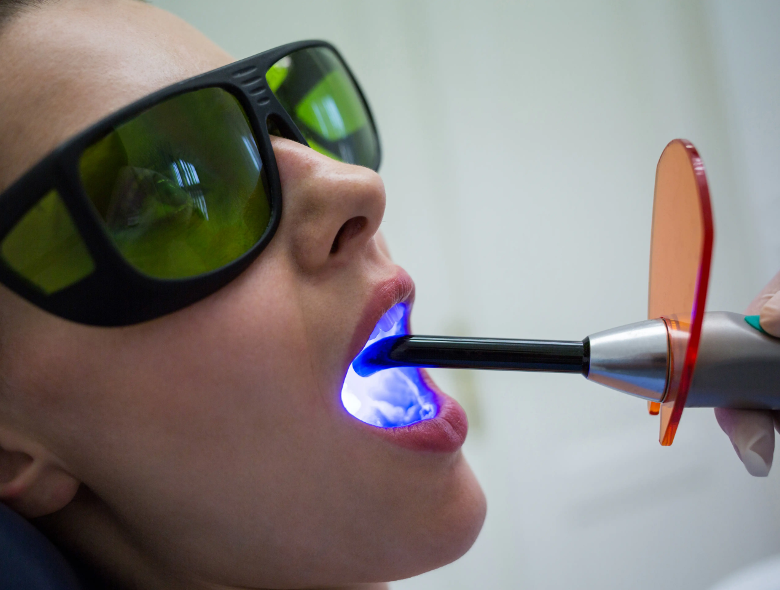
A NaturaDent Lézerfogászatán a folyamat következő lépése, hogy a fogorvos szükség szerint eltávolítja a fog külső felszínének egy részét, majd lézerrel előkészíti a felszínt, ami az esetek döntő többségében egyáltalán nem jelentős, csak a zománcot érintő felszíni előkészítés.
Erre a felületre kell felhordani több rétegben azt a nagyon erős kompozit anyagot, ami rétegenként szárad és szilárdulását követően nagyon erősen kötődik majd a fog felszínéhez.
Az így felvitt anyagot a fogorvos a megfelelő eszközökkel csiszolja és polírozza azért, hogy mind az árnyalat, mind a megjelenés tekintetében tökéletes esztétikai eredmény születhessen a tartósság mellett.
Természetesen a direkt héj elkészítése ennél sokkal több lépésből is állhat. Egy nagyobb átalakítás esetén ugyanis a rétegekben felhordott anyag nem mindig hozza a várt eredményt. Ezt a fogorvos már előre látja – ezért fontos a vizsgálat – és más alternatívát javasol.
A megoldás ilyen esetekben a kerámia héj, ami valójában nem más, mint egy mintavétel után precízen kialakított fogpótlás.
A kerámia héj egy indirekt héj, hiszen a fogra kerülő héjt fogtechnikus készíti el, itt a koronához mérten sokkal kevesebb foganyag elvesztésével jár, de nagyobb előkészületet igényel, emiatt több kezelés szükséges hozzá.
Ebben az esetben ugyanis már elengedhetetlen lenyomatot venni a fogról, ami alapján rendkívül ellenálló préskerámiából fogtechnikus által készül az indirekt héj, majd csiszolást követően ezt ragasztják a fogra, amivel akár a nagyobb elváltozások is orvosolhatók.