Direct veneers allow for immediate transformation, giving you an aesthetic, radiant Hollywood smile. We reveal the secret to actors' perfect smiles. Direct veneers help remove discolouration from teeth; with direct veneers, we can restore the shape and form of broken or worn teeth, with a quick procedure, no drilling, and painlessly.
What is a direct shell?
A direct veneer is a special tooth restoration material that we apply to the front teeth to eliminate minor dental imperfections and discolouration. The direct veneer is made by the dentist during the treatment, so you can see and try out your new teeth immediately. Its advantage is that you don't have to wait for it, as it's not made by a dental technician, thus resulting in an immediately perfect smile.
When do we recommend direct veneers?
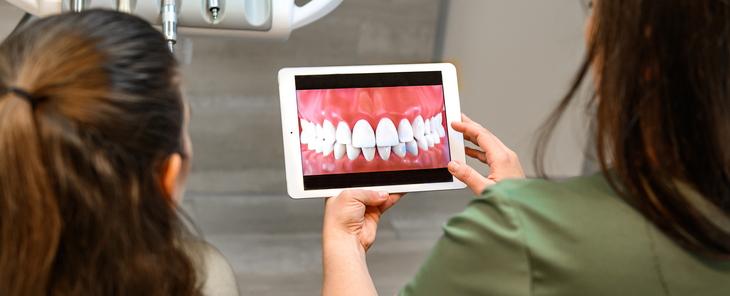
We recommend the direct veneer application for our patients in cases of aesthetic flaws, as it does not resolve health problems. We recommend the direct veneer for aesthetic issues such as discolouration of tooth enamel, too large gaps between teeth, chipped front teeth, gums that are too raised due to periodontal disease or the shape or form of a tooth that is not in the right place due to.
These surface imperfections can be easily concealed with direct veneers, allowing for a quick change in the shape and colour of your teeth. And you can have a Hollywood-worthy smile immediately! Would you like to try out your new smile? Book an appointment at our practice and our colleagues will be happy to help you!
In the following cases, the use of a direct shell is an effective, quick and durable solution:
- For discoloured, aesthetically displeasing teeth, where tooth extraction or crowns are not required, but teeth whitening is not effective.
- Fast orthodontic treatment for cases where aesthetic closure of gaps between teeth or other issues, such as mild crowding, need to be resolved.
- To cover or reinforce incisors that have been previously filled but are discoloured compared to the filling.
- To restore tooth surfaces that have been worn or damaged by external influences.
- For correcting disproportionate, too flat or too pointy teeth.
Which teeth can you apply direct veneers to?
The direct veneer is prepared by the dentist at NaturaDent Laser Dentistry according to your needs. Direct veneers are most often used for the front upper teeth, but sometimes direct veneers are also made for the lower front teeth. Of course, direct veneers can be made for several teeth simultaneously, but we can also shape a single tooth if desired.
How is the direct shell made?
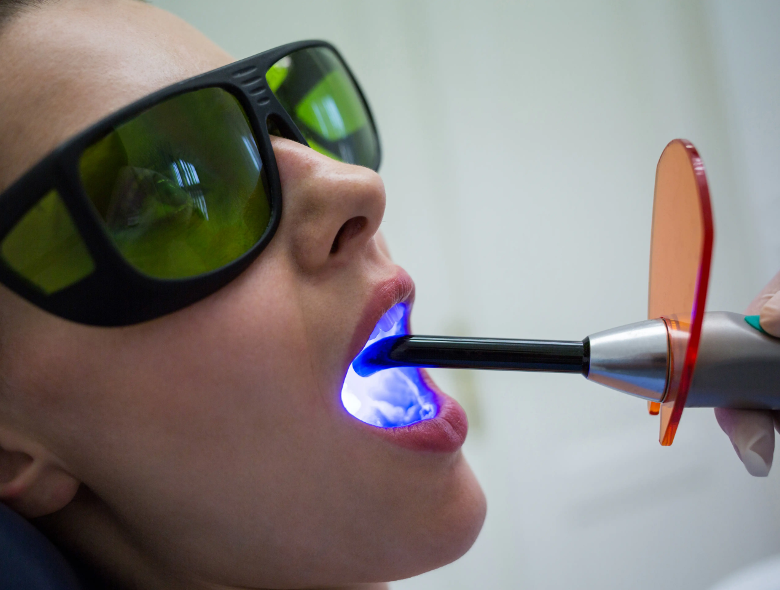
No drills are used before the direct shell is made, only the tooth surface is conditioned with lasers and other dental materials. This procedure is not painful at all, it only serves the purpose of allowing the restoration to adhere over a larger surface area and to achieve a durable result.
Preparing the direct shell step-by-step
When creating a direct veneer, the most important thing to know is that it is always tailored to the patient, but the main points are, of course, the same. Let's look at how a direct veneer is made, step by step:
Consultation:
The process always starts with a consultation with a dentist, a general assessment of your condition, which will determine the next steps.
Preliminary interventions:
If the health check reveals any problems that require prior intervention, it is essential that this is done. This could include, for example, the removal of dental plaque, as a direct shell cannot be built directly on a calcified tooth.
Preparation:
If the patient's dentition is ready for the procedure, the dentist will prepare the teeth immediately before the shell is created, so old fillings are removed and the tooth surface is cleaned to match the structure.
Shell design:
The direct shell is applied layer by layer to the prepared teeth. The dentist uses a special composite material to create a surface that matches the shade and shape of the other teeth.
Polishing:
Once a direct shell is created, the dentist can use polishing to bring the surfaces together and create a glossy finish that can give the final result a completely lifelike appearance.
For an existing direct shell
If you come to our practice already having an indirect shell, we can also remove it easily. We also do not use a dental drill to remove the direct shell. Even though traditional direct shell removal usually involves drilling the shell, at NaturaDent Laser Dentistry, the procedure is done differently.
No inconvenience even with an existing direct shell
You will not feel an unpleasant drilling in your teeth, as we remove it using a laser. To remove it with our hard tissue dental laser, thanks to its tissue-specific properties, only the composite material of direct veneer is removed.
There is no pain or tooth sensitivity. After surface preparation, the new direct veneer can be made immediately.
Perfect colour and shape immediately
With ceramic direct veneers, you can quickly change your smile with spectacular results, without loss and without major intervention. Now you know the secret of Hollywood stars!
A quick solution, pain-free, with perfect smile results. The veneers can be coloured to the desired shade and will blend in perfectly with the rest of your smile.
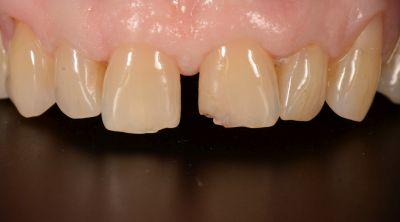
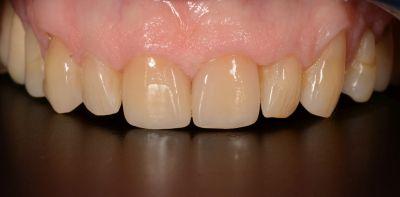
Our patient's before-and-after photo with direct veneer application.
When is direct veneer not recommended?
The direct veneer offers a quick solution in many cases, however, its applicability requires certain conditions. The use of direct veneer is contraindicated in the following cases:
- In cases of significant tooth loss, when so much of the crown is missing that the shell cannot be properly and permanently fixed.
- For structurally weakened teeth that are fragile or unstable, or already severely damaged (e.g. cracked).
- For severe bite disorders that can only be corrected with braces.
- For people suffering from teeth grinding, or bruxism.
- Poor oral hygiene that has already resulted in active dental disease, such as tooth decay or periodontal disease.
Direct shell or ceramic shell?
When someone wants a dental shell, a common question is which type to choose. There are some fundamental differences between the two procedures. Here are the most important ones.
Hello there
The biggest advantage of a direct shell is that it is very quick to make, with only one time needed to form it in most cases. The big advantage is that there is minimal tooth loss and it is built directly onto the existing tooth surface by the dentist.
A skilled dentist can perfectly replicate the appearance of real teeth in terms of both shape and shade, and their durability is comparable to that of composite fillings, and overall, they are cheaper than ceramic veneers.
Ceramic shell
The disadvantage of this method is that it requires several sessions in each case and can take days or even weeks before the patient receives a final shell, as this is made by a dental technician on the basis of an impression taken of the tooth.
It typically requires the removal and grinding of more tooth material, but it is extremely durable and wear-resistant, and will last for many years, but is of course more expensive.
Frequently asked questions
Does it hurt to make a direct shell?
Since the treatment is always carried out under anaesthesia, the patient typically experiences no pain during the direct veneer preparation or from the preliminary procedures.
How long does it take to make a direct shell?
It is always patient-dependent, as it determines how much preparation is required and how many teeth are involved. The dentist himself will therefore be able to answer this question precisely before the treatment.
How durable are direct shells?
It is variable, as the patient's oral hygiene is a key factor in determining this. Generally speaking, direct veneers can be compared with the durability of dental fillings, i.e. they can last for an average of 7-10 years or even longer.
Can the direct shell discolour?
As with dental fillings, of course, the direct shell can also become discoloured, especially after drinking too much coffee, tea or red wine, but smokers also have this problem and tartar can also settle on the surface.
Can the direct shell be repaired if damaged or broken?
As with tooth filling, it can be easily rebuilt after removing the old shell if it is chipped or damaged.
What special care does a direct shell require?
It does not require special care, but it is just as important for good oral hygiene as healthy teeth.
Can teeth be sensitive after the direct shell is built up?
It is not common, but temporary sensitivity may occur immediately after treatment, especially to foods that are too hot or too cold.
How often does the direct shell need to be checked?
It needs no more check-ups than healthy teeth, so it's worth visiting your dentist every six months, who will of course also check the condition of the direct veneers.
Does a direct shell protect against tooth decay?
No, a direct shell is like a dental filling. Underneath, tooth decay is rare, but it can occur along the edges, so good oral hygiene is essential.
Can the direct shell be bleached?
No, like tooth filling, the direct shell does not respond to whitening. If it becomes too discoloured, it can be replaced to match the shade of the other teeth.