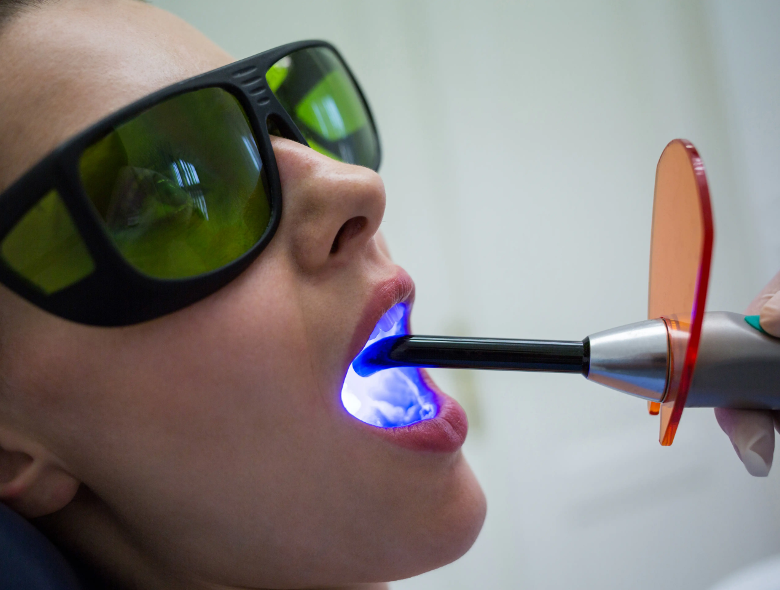
Root canal treatment is currently one of the most commonly performed tooth-preserving treatments, with which we can eliminate inflammation in the teeth and preserve the health of the teeth for many years.
In our article, you can find out how we perform this treatment painlessly, complemented by modern laser dentistry equipment and a dental microscope, for maximum precision and effectiveness.
When is root canal treatment necessary?
Root canal treatment becomes necessary when inflammation within the tooth reaches the pulp, causing very painful symptoms. The inflammation is caused by bacteria that, by entering the tooth, also reach its inner layers. This typically occurs in cases of extensive, severe tooth decay, but can also develop through decay under an old filling, or due to an accidental dental injury or tooth fracture.
In many cases, tooth decay or a fractured tooth can be restored with an aesthetic dental filling or restoration. Root canal treatment is only necessary if a dental panoramic X-ray reveals that the pulp inside the tooth has also been damaged as a result of bacterial infection, and the decay has already reached the layer of blood vessels and nerves within the tooth.
The most common symptoms of tooth root inflammation are:
- Pain when consuming hot or cold foods and drinks
- Pain, sensitivity when biting or chewing
- Blue, loose tooth
- Swollen gums around the affected tooth
- A painful, throbbing sensation around the tooth
- Pus-filled discharge alongside fog
- Arc duzzanata
- Discolouration, greying of the fog
If you experience any of the above symptoms and the pain around the tooth does not go away, see your dentist as soon as possible. The painkillers or anti-inflammatory rinses taken for toothache do not eliminate the inflammation in the tooth, they only temporarily treat the symptoms. The tooth needs to be treated, so it's worth seeing a dentist as soon as possible while the tooth can still be saved.
How does root canal treatment take place at our practice?
Painless root canal treatment at Naturadent under general anaesthesia, in addition to laser dentistry and microscopy. The treatment is gentle, and once the inflammation is gone, the pain is steadily reduced, the discomfort disappears and the tooth lasts for many years.
Treatment is always preceded by a dental X-ray. Our dentists will then determine the extent of decay and inflammation in the tooth and whether root canal treatment is necessary.
To ensure that the treatment is completely painless, local anaesthesia is used. Once the area around the tooth has become completely numb, our dentists use a laser to open the tooth to access the root canals.
A Biolase dental laser By using it, we can gently remove the damaged tooth surface without damaging the healthy parts of the tooth. Our patients feel absolutely nothing from this, thanks to the anaesthesia and the gentleness of laser dentistry tools.
A special endpiece is attached to the laser head, which reaches the root canal and destroys bacteria on the entire surface of the root canal. During this process, the tooth is completely disinfected., We shall remove the infected pulp causing the pain, as well as the bacteria causing inflammation, completely. from inside the tooth.
After the pulp has been removed, the dentist places a medicated temporary filling in the cleaned canal to fully resolve the inflammation before placing a permanent root filling in the tooth.
Thanks to the beneficial effect of the laser used during root canal treatment, we can create a completely sterile surface in the tooth cavity, which allows for better, more stable bonding of the final filling and prevents the formation of future problems in the gap between the tooth surface and the filling material.
Depending on the extent of damage to the tooth material, a root-treated tooth may also receive a dental crown in order to save the tooth, in cases where there is not enough healthy tooth material left for a filling.
Root canal treatments in our clinic supplemented with a microscope we also do. The inside of the teeth, the root canal itself, is very difficult to see with the human eye and with a magnifying glass. This is remedied by the dental microscope, which allows us to carry out treatments requiring extreme precision, such as root canal treatment, at magnifications of up to 31 times.
Thanks to this unique method The success rate of root canal treatments performed at Naturadent is exceptionally high compared to traditional procedures..
What to do after root canal treatment?
As with all dental treatments, for root-treated teeth it is most important that the inflammation around the tooth heals, so to prevent the tooth from becoming inflamed again, follow your dentist's instructions.
While there is a temporary filling in the tooth, It is advisable to avoid consuming hard foods.. In general, we recommend that patients eat soft foods, soups, stews, or food cut into small bites during this time, and avoid chewing on the affected side.
We also do not recommend the consumption of carbonated or sugary soft drinks, coffee, tea or alcohol. as the sugary and acidic environment encourages the re-establishment and proliferation of bacteria. Also avoid chewy, sticky foods, as these can easily stick to the root-treated tooth, thereby loosening the temporary filling, which may then even fall out.
If the filling becomes loose or falls out, bacteria can re-enter the tooth, which may necessitate further treatment. If there is a risk of your temporary filling coming loose, or if you feel your filling is moving, you should definitely visit your dentist., before the root-treated tooth is damaged or further inflammation develops.
It's not worth putting off a root canal treatment.
If you need a root canal treatment for your toothache, make an appointment for a dental check-up and contact our expert dentists! At Naturadent, root canal treatment is carried out under anaesthesia, gently, with laser dentistry and microscopic instruments. Thanks to our modern equipment, the result will be precise and long-lasting.
Do not delay treatment! If you see your dentist in time, root canal treatment can help to eliminate the pain and save your tooth. The inflammation in the tooth will not go away on its own, the pain will only get worse, and in the end, the inflammation may even lead to the complete loosening or loss of the tooth.