A number of triggers can lie behind a festering tooth. Most commonly, it develops due to inadequate oral hygiene, but it's important to know that none of this happens overnight. The development of a festering tooth can often take many months.
Its effect can lead to very unpleasant symptoms, such as inflammatory discharge leaking from around the tooth, abscesses, and significant swelling, accompanied by excruciating pain. However, there is also a stealthy form, where suppuration around the tooth root is only visible on an X-ray, all without any symptoms and painlessly. This is very dangerous, as if left untreated, the loss of the tooth is soon predictable.
Previously, the only way to treat a festering tooth was to remove it. Nowadays, however, there are alternative procedures that can save even a festering tooth in most cases.
For example Among NaturaDent's services, laser root canal treatment is available.!
What is a purulent tooth, what symptoms does it cause, and how does laser root canal treatment proceed? We will answer these questions in our article!
What do we call a pus-filled tooth?
Generally speaking, a purulent tooth can be considered a sort of umbrella term for Dentistryban, as we can distinguish several forms of it.
In this case, pus is an inflammatory exudate saturated with pathogens, typically bacteria, and tissue debris, which can appear in several places.
For example, it can occur inside the tooth, at the tooth root, but it can also break out in the direction of the gum, which can result in the appearance of sacs filled with so-called purulent discharge.
When and what form it takes depends on the patient, as sometimes it is caused by the underlying causes, sometimes by neglected oral hygiene, or even by the anatomy of the teeth.
If our body senses that bacteria have penetrated the tissues around the teeth, the immune system initiates its own defence mechanism. This causes inflammatory tissues and cells to appear on the affected surface.
These cells, however, not only destroy bacteria, but also the surrounding, usually still healthy tissue elements. This is where pus forms, which poses several dangers due to the underlying processes.
It is very important to always take an abscessed tooth seriously, as we are talking about a type of infection that can spread towards deeper tissues, thereby causing more serious complications.
This is usually when we see swelling in the face or inflammation in other parts of the body.
How does a pus-filled tooth develop?
As we've already written above, the formation of a pus-filled tooth is always a lengthy process, an initiation of a domino effect in the mouth, so to speak, which never occurs without prior causes.
Most of the time, it all starts with poor oral hygiene, which gradually triggers a series of negative processes.
Problems related to oral hygiene are most often followed by tooth decay. If the patient does not see a dentist and does nothing to reverse the process, pulp death can occur.
A dead tooth socket is very easily infected, so it only takes a few bacteria in the wrong place for this to happen.
Toxic substances associated with the bacteria can then seep through the root tip into deeper tissues, reaching the periosteum and even bones and connective tissues.
Typically, the immune system joins the process here. After detecting the pathogens, it initiates its natural resistance, which causes inflammation to develop in the environment.
As discussed in the previous paragraph, inflammation produces pus - usually at the root tip - which, after accumulation, seeks its way to the outside world.
Its effects can lead to the formation of a cyst at the root tip, a pus sac on the surface of the gum, and in severe cases, by affecting deeper tissues, the pus can cause severe inflammatory consequences in the body.

What are the complaints of a pus-filled tooth?
The symptoms of genital herpes are always influenced by the patient's condition and the progression of the disease.
One of the most common complaints is pain, which can range from mild to excruciating. It's common for patients to only see a dentist when a festering tooth causes significant pain.
As the pus-filled lesion often shows no visible symptoms at first, toothache doesn't necessarily mean there isn't an infection. However, most of the time, the pus finds its way to the surface, resulting in the formation of a fistula or abscess.
A characteristic symptom is the periodic discharge of pus from these areas. At such times, the pain may lessen, but the appearance of pus always suggests that there are deeper, severe inflammatory processes and that the bone tissues around the root of the tooth are also being destroyed.
A general complaint in such cases due to the emptying of the stomach is also unpleasant breath, which cannot be alleviated by regular brushing or other methods – at best, it is only temporary.
In an advanced stage, an abscessed tooth often becomes completely sensitive, so the patient may experience pain even when biting, which is usually accompanied by swelling and redness of the gums, the latter of which can also spread to the face.
In the event that pus from a tooth cannot break through to the surface, it will move in the opposite direction and force its way towards the deeper layers.
Not only does this cause immense pain, but in addition to significant swelling of the face, deeper areas can become infected, which can lead to a host of complications.
Plaque can appear under the crown and the filling.
Besides poor oral hygiene, the formation of a pus-filled tooth is also very common under crowns and fillings. This problem can develop, sometimes even without symptoms for a long time, especially behind larger and deeper dental fillings, as well as under older crowns.
The reason is that bacteria can enter the root canal, which can cause inflammation at the tip of the root.
Since the abscessed tooth does not cause any symptoms for a long time, it is possible to develop a significant bone spur, such as a cyst, at the root apex without the patient having any symptoms or pain.
It is not uncommon that in the case of a pus-filled tooth, there is only one during a routine check or discovered when a dental X-ray is taken.
However, treatment is still essential in these cases, because despite being asymptomatic, the patient is effectively carrying a ticking time bomb in their mouth, which can lead to serious complications.
Antibiotics do not cure an abscessed tooth.
From a treatment perspective, a common misconception regarding purulent teeth is that antibiotics provide a solution. When pus appears, many people ask their GP for some kind of antibiotic, as this preparation can effectively combat bacteria.
Although all of this must be treated as fact, it should be known that antibiotics do not cure an infected tooth. They can provide temporary relief from symptoms, and even reduce pain; however, they do not reach the inside of the tooth and cannot exert their effect there.
So, in a purulent infection, it may be able to restore the area around the tooth, but it will not eliminate the underlying problem, so a few days after the antibiotic treatment, the symptoms will reappear and cause serious discomfort.
Therefore, if an infected tooth is suspected, a lasting solution is needed instead of antibiotics, one that doesn't involve tooth loss. Laser root canal treatment is one such solution!
Laser root canal treatment is a permanent solution for a festering tooth.
At NaturaDent, laser root canal treatment is also available, offering one of the most modern methods for those seeking an effective solution for a festering tooth.
It is excellently applicable when a panoramic X-ray indicates bacterial infection of the tooth pulp and inflammation of the tooth root, which, as we know from the above, can initiate pus-producing processes in the mouth.
Many people dread root canals as much as tooth extractions, even though they are virtually painless nowadays. Furthermore, excellent results can be achieved with the Biolase dental laser used by NaturaDent.
However, this is not all, as in our clinic, which is committed to the most modern Western technologies, we perform the procedure with a special microscope, with which we can carry out root canal treatment at 31x magnification, thus providing not only a faster but also a more effective result.
The procedure for laser root canal treatment in case of a purulent tooth
In addition to high-quality equipment, one of the secrets of modern dentistry lies in careful planning and the precision of the interdependent processes.
As it is very important to investigate the cause of a pus-filled tooth, our practice always takes a comprehensive dental X-ray before treatment. This precisely reveals the extent of the inflammation to our dentists.
If our colleagues decide that the lesion can be treated with laser root canal treatment, the procedure will always be carried out under local anaesthesia.
This allows the treatment to be carried out painlessly, as the tooth must be thoroughly exposed, for example, opening the root canals, which without anaesthesia is significant With pain iron.
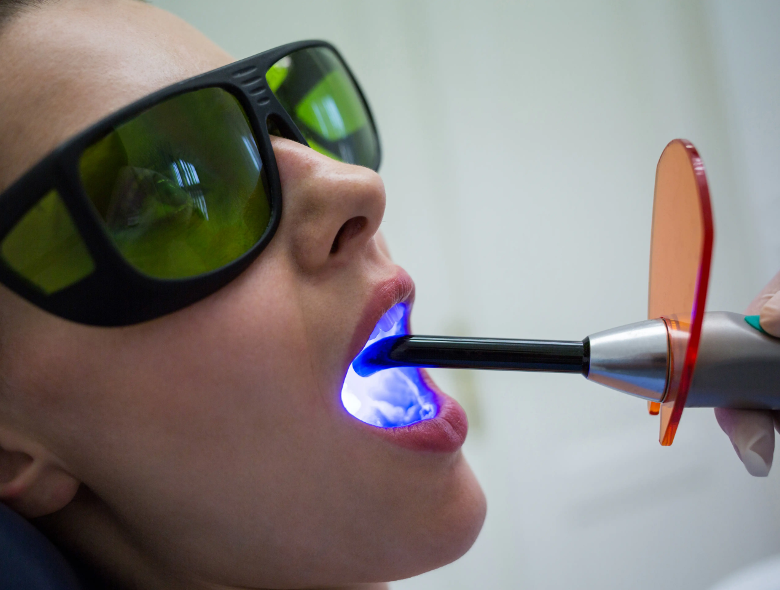
In such cases, we use the Biolase dental laser to remove damaged tooth surfaces, which is not only quick but also precise, thus not damaging the healthy parts of the tooth.
Following the exploration, a special laser head can be used to destroy bacteria in the root canal area, completely remove the painful and inflamed dental pulp, and disinfect the entire related surface.
Following the removal of infected material, a temporary medicinal filling is placed in the cleaned root canal, which helps to eliminate inflammation of the surrounding area.
This can be replaced with a definitive root filling a few weeks later, provided the patient's symptoms have completely resolved.
If enough tooth material remains after treatment, the tooth can be sealed with a tooth-coloured aesthetic filling; in other cases, a crown may be necessary.
Google patient review:
É. Etelka Erika:
A truly pleasant, clean environment, with a short waiting time for appointments.
I presented with a 1.5 cm x 2.5 cm cyst. Elsewhere, they would have removed 2 of my teeth as a solution.
Dr. Zakeri Elahe, a NaturaDent dentist, is currently treating my problem. Bone loss has begun, but I can save my teeth. As a 30-year-old young mother, the thought of losing one or more of my teeth was dreadful. Due to Dr. Elahe's kind, patient-centred approach, I always arrive with peace of mind. In my experience, she keeps me informed throughout treatments, asks questions, and is in constant contact with me.
I heartily recommend her and the other dentists who work at NaturaDent.